Borosilicate glass can be considered for a premium spirits bottle when its verified material, design and manufacturing route suit the complete packaging project. The buying decision should cover the bottle, closure, decoration, filling conditions and distribution plan, rather than the material name alone.
For a whiskey, brandy, gin, rum or other spirits launch, the objective is not simply to buy an unusual glass object. It is to approve a package that communicates the brand, holds the intended beverage, works with the selected stopper and can be supplied on agreed terms. An attractive first sample is the beginning of that assessment, not the end.
This guide combines three workshop videos supplied by RS Glass & Jingbo Glass with practical purchasing questions, comparison tables and a reusable quotation brief. The clips show glass-working operations. They do not independently verify a glass grade, demonstrate a complete production cycle or establish a finished bottle's performance. Technical references are identified where used; suggested buying checks are not presented as completed factory tests.
When should a spirits brand consider borosilicate glass?
Consider borosilicate glass when a proposed construction or distinctive design offers a useful fit with your brand and operational requirements. Ask the supplier to explain the actual material and forming route before choosing between a specialty glass project and a conventional bottle proposal.
A sculptural decanter, an unusual contour or a separately formed glass detail may justify a development discussion. Start by describing the intended customer experience: the view of the liquid, the balance in the hand, the opening action, the pour and the presentation in its box. Decide which features make the package recognizable and which can remain flexible during engineering.
For a limited release, the priorities may be appearance and an achievable launch quantity. For a recurring product, consistency, reorder planning and compatibility with the filling operation may carry more weight. Neither situation automatically selects a particular glass family. The appropriate proposal is the one that addresses the actual brief with evidence and a workable commercial scope.
Prepare a short decision statement before requesting samples: what must this bottle achieve that an existing model cannot? If the answer is only a printed brand mark or a different stopper appearance, compare a simpler adaptation as well. Keep the development route proportionate to the benefit that the consumer will actually notice.
What does the borosilicate material designation actually mean?
It identifies a glass material family, while the proposed grade and its supporting documents identify what is being offered. A photograph, a flame-working video or a descriptive product name cannot establish the composition of a particular bottle.
As a technical reference, SCHOTT's DURAN product information lists a mean linear thermal expansion coefficient of 3.3 x 10^-6 K^-1 over 20-300 degrees C for its named borosilicate 3.3 glass. That is information about the identified SCHOTT material, not an RS Glass & Jingbo Glass bottle specification, a finished-package temperature limit or proof of an equivalent supply.
Ask the supplier to connect its material declaration to the actual project: the proposed glass designation, the component concerned and any applicable supporting record. If a design combines separately sourced components, establish whether one material statement covers everything or only one part. Keep the answer with the drawing and quotation so later substitutions can be assessed.
Do not treat clear, extra-clear, crystal-white, premium and borosilicate as interchangeable descriptions. Some terms communicate an appearance expectation; others refer to a composition or grade. Convert each important claim into a specific question with an identifiable answer. If the material remains unconfirmed, record it as an open approval item instead of silently assuming a particular grade.
Is borosilicate better than conventional glass for every spirits bottle?
No single material label establishes the best finished package for every spirits project. Compare the proposed designs, supporting evidence, manufacturing arrangements and total purchasing scope on the same basis before deciding.
Conventional molded bottle proposals and specialty borosilicate proposals may involve different designs and production routes. Ask each supplier to identify its actual offer rather than assuming every conventional bottle is identical or every borosilicate bottle is handmade. A meaningful comparison needs the same intended fill, closure concept, decoration, order quantity and delivery destination.
Do not use laboratory glass characteristics as a substitute for evaluating a beverage package. Likewise, a heavy base, thick-looking wall or expensive surface treatment does not by itself establish impact resistance or suitability for your filling process. Review the finished sample and the relevant checks for the intended application.
| Purchasing decision | Question for each proposal | Record to retain |
|---|---|---|
| Material identity | What glass grade is actually proposed? | Material statement linked to the project |
| Construction | Which parts are formed, joined or assembled? | Drawing and process explanation |
| Functional fit | What bottle and closure combination is included? | Paired component drawings and sample |
| Repeat supply | Which features and variations are controlled? | Acceptance criteria and change procedure |
| Distribution | What packing and route are assumed? | Packing proposal and evaluation scope |
| Commercial basis | What does the quoted amount include? | Itemised quotation with validity |
Use the completed comparison to identify trade-offs. An existing design may reduce development work; a new design may justify additional evaluation. Neither choice should depend on an unsupported claim that one glass family is automatically superior.
What makes a premium whiskey or spirits bottle feel considered?
Premium presentation comes from a coherent combination of shape, handling, closure, decoration and packaging. Define that combination through physical references and acceptance criteria instead of asking for a bottle that merely looks luxurious.
Review the silhouette from the front, side and normal shelf distance. Consider how the liquid changes the appearance, where the main label will sit and whether the most important brand information remains legible. An impressive close-up photograph does not answer these questions. A simple mock-up with the intended label proportions can expose conflicts before artwork and tooling are finalized.
Then assess the hand experience with an appropriate sample. Discuss gripping, opening, pouring and reclosing, including the experience after the bottle has been opened repeatedly. An unusual contour should have a clear purpose; decorative details should not make routine handling awkward. Where a trial requires the intended beverage, agree the trial scope with the responsible filling and quality teams.
Finally, evaluate the presentation box and insert alongside the bottle. A gift package should not force the buyer to grasp a delicate feature to remove the bottle. Leave suitable access to the intended grip area and closure. Record the complete presentation reference, not just the empty bottle, so the approved visual direction survives later changes to the cap, label or box.
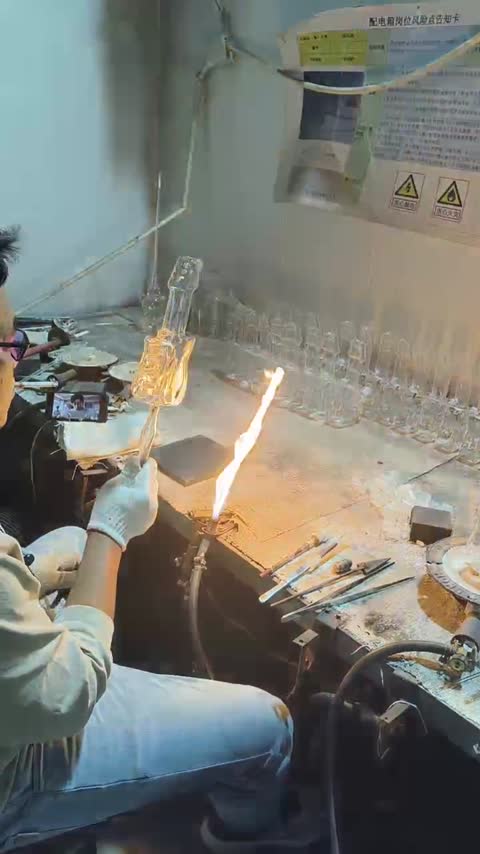
What does the first workshop video show about local flame working?
The first clip shows a glass piece being worked near a flame at a forming station. It gives buyers a visible starting point for discussing geometry and process, but it does not measure the material, working temperature or finished bottle performance.
Use this view to ask which areas of the proposed design are formed during the operation and which functional dimensions must remain consistent. Request a marked drawing for the neck interface, base contact area, decorative transitions and any connection points. A short video is easier to interpret when the supplier identifies the part and the stage it represents.
For a custom borosilicate spirits bottle, ask whether the footage illustrates the proposed construction or only a related workshop technique. If the actual design needs another operation, request an explanation of that additional step and its approval implications. Avoid treating every visible piece as an available finished product.
The useful purchasing outcome is a more precise sample brief: what is being formed, which dimensions matter, how appearance is judged and where later inspection applies. This is manufacturing footage, not consumer heating guidance. It does not justify applying a flame to a filled alcohol bottle or copying workshop operations outside an appropriate professional setting.
What should buyers learn from the second video of manual shaping?
The second clip shows a worker handling a shaped glass component near a burner. Its value is the visibility of a manual operation, which helps buyers ask better questions about repeatability, reference samples and functional tolerances.
Separate the visual brief from the technical acceptance criteria. A decorative curve may need an agreed appearance range, while a stopper interface needs defined dimensions and an assessed component match. Asking only for every bottle to look exactly like a single photograph leaves both parties without a practical way to judge production pieces.
Request enough representative samples to discuss the intended inspection scope rather than basing every approval on one carefully selected object. Ask how the sample set relates to the planned manufacturing route, and record which stage each sample represents. A shape sample without final decoration or a matched closure should not be described as approval of the complete package.
Keep the approved reference, drawing revision and artwork together. If the project includes an internal feature or a joined element, ask whether it contacts the beverage and what documents and checks apply to that exact construction. This clip alone does not establish capacity, output, liquid compatibility or whether every piece shown has passed inspection. Those questions belong in the project record and sample approval plan.
Why does the third detail-working video matter to the bottle brief?
The third clip shows manipulation of a glass piece at a bench flame-working station. It encourages a closer discussion of small features, their purpose and how they are evaluated as part of the complete bottle rather than as isolated decorative details.
Ask the supplier to identify the feature being worked and whether it is relevant to the proposed product. A fine detail may influence the appearance reference, an assembly interface or how the bottle sits in its insert. Make the required result visible on a drawing or annotated sample photograph, then agree how deviations will be reviewed.
Also ask which finishing and annealing stages apply to the actual construction and which inspection records can be supplied. This video does not show a complete annealing cycle or prove that a stress-related check has passed. Keep the discussion at the level of documented process and finished-sample approval rather than inferring a result from a flame or a workbench.
Review the whole object again after reviewing its details. The base, neck, closure and decoration must still work together. A feature that looks effective in a close-up may be obscured by a label or interfere with the box insert. Approve its place within the complete package before committing to a production reference.
What belongs on a custom borosilicate bottle drawing?
A purchasing drawing should identify the design and its functional requirements clearly enough for sampling, quotation and inspection. Agree which dimensions and features are critical instead of relying on an attractive rendering as the manufacturing specification.
Begin with the drawing number, revision, units and intended model identity. Include the principal dimensions, capacity description, neck interface, base contact area and relevant decoration zones. Where a dimension affects another component, make that relationship clear. A stopper, box insert or filling arrangement should not be designed from an unverified marketing image.
Ask the supplier to propose realistic tolerances for the actual process and explain any feature that needs adjustment. Avoid imposing arbitrary precision across every surface. Prioritize the dimensions that affect function and agree how more expressive features are judged. Where the appearance is important but difficult to capture numerically, retain an identified physical reference alongside the drawing.
Record unresolved items directly in the approval list. For example, a rendering may show the intended silhouette while leaving the final neck detail open. That can be a useful development stage if everyone understands the limitation. Before releasing production, replace assumptions with approved information and circulate the same revision to the bottle supplier, closure supplier, decorator, filler and packaging team as applicable.
How should capacity, fill level and appearance be agreed?
Specify the intended sale volume and ask the supplier and filler to confirm how the actual bottle accommodates the filling plan. Capacity should be an agreed project requirement, not an estimate taken from a photograph or the apparent size of a decanter.
State the intended nominal fill, beverage and filling conditions when requesting a quotation. Ask which capacity information will be provided and how the relevant measurement is defined. If several capacities are under consideration, compare separate drawings rather than assuming a design scales without affecting the neck, proportions or presentation.
Use a sample to review the intended visual fill level. The position of the liquid may change how an internal detail or main label reads, and the effect should be checked with the complete design concept. Record the appearance reference together with the technical filling requirements; one does not replace the other.
If you are comparing 500 ml, 700 ml and 750 ml bottle concepts, make clear which is the actual launch specification and which are future alternatives. The capacity examples are planning options, not a claim that every model shown in the videos is offered in those sizes. Confirm the selected design, drawing and availability before using a capacity in a purchase order or product announcement.
How do you match a bottle neck with a stopper or cap?
Match the actual bottle and closure drawings, tolerances and samples as a pair. A similar-looking opening or a nominal size does not by itself establish sealing, insertion, removal or repeat-use performance.
As a reference for threaded container terminology, Berlin Packaging's neck finish guide distinguishes dimensions such as the inside opening, outside thread diameter and finish height. The guide helps explain why a neck is not described adequately by one number. A stopper project still needs the dimensions and contact geometry relevant to that particular closure, rather than a thread specification copied onto a different system.
Give RS Glass & Jingbo Glass the existing closure drawing when you want to reuse a cap or stopper. If available, include an identified physical sample and the closure supplier's relevant specification. The company can discuss drawing-based matching and evaluate adjustments, but feasibility, tooling, cost and the final paired sample must be confirmed.
Include practical use in the approval discussion: assembly, opening, reclosing and the intended seal assessment. Identify who approves the bottle, who approves the closure and who approves the combination. If either supplier changes a functional dimension or material, review the pair again. A shared approval record is more useful than two separate statements that each component looks correct on its own.
How should decoration and internal design details be specified?
Define decoration by its artwork, location, process and relationship to the beverage and handling surfaces. Confirm which features are external, which contact liquid and which require additional project-specific evaluation before approving the complete package.
Provide editable artwork or an agreed production file, color references, dimensions and position limits. Mark areas reserved for labels, printing, frosting or other proposed treatments. Ask whether the exact surface and shape can support the intended result, and request a decorated sample where the appearance is material to the launch decision.
Do not assume an external decorative sample establishes suitability for an internal feature. If a design includes a component inside the vessel, request a description of its construction, liquid-contact surfaces and the supporting documentation for the intended use. Avoid claims such as lead-free, food-safe or universally alcohol-compatible unless the actual project has appropriate evidence supporting that wording.
For handling and presentation, discuss the interaction between the decoration, the closure and the insert. Consider whether routine packing or use could place contact on a prominent decorated area and how that risk will be evaluated. Keep the accepted appearance range and relevant checks in the approval record. See the spirits bottle decoration guide for additional questions when comparing treatment proposals.
What documentation is needed for the intended spirit and market?
Ask for documents and checks that apply to the actual finished package, intended beverage and destination. A generic glass statement, a laboratory product page or a workshop video is not a substitute for project-specific suitability evidence.
Prepare a use description for the supplier and the responsible quality or regulatory team. Include the spirit, alcohol strength, relevant product characteristics, filling conditions, storage expectations and intended market. Identify the closure, liner, decoration and any assembled or internal parts, so the assessment is not limited to the bare glass body.
For each document supplied, check what product or component it identifies, its scope and any stated limitations. Ask whether it covers the proposed construction and whether changes to the material, decoration or closure would require another review. Keep unresolved questions visible before ordering, rather than relying on a certificate title without reading what it covers.
This guide does not claim a food-contact approval, a universal chemical compatibility result or a completed regulatory assessment for a bottle shown in the videos. It also does not provide a blanket checklist of legal requirements for every country. Establish the applicable requirements with suitably qualified parties for the destination and intended use, then keep the resulting evidence linked to the approved project revision.
Which sample stages should come before a bulk order?
Use a staged sample plan that separates appearance development from approval of the complete production package. Name the purpose of each stage, its open issues and the decision needed before the next commitment.
An existing reference can help discuss shape and proportions. A development sample can help resolve a proposed change. A matched bottle-and-closure sample can support functional review, while a decorated and packed sample can address the final presentation and distribution proposal. These are possible approval stages to agree, not a claim that every project follows an identical factory sequence.
| Sample stage | Main buying question | Approval limit to record |
|---|---|---|
| Visual reference | Is the design direction appropriate? | Which technical features remain open? |
| Development sample | Are the proposed changes acceptable? | Which materials or details are provisional? |
| Bottle and closure pair | Does the selected combination meet the agreed review scope? | Which filling and seal checks remain? |
| Decorated package | Is the complete presentation acceptable? | Is packing evaluation still outstanding? |
| Agreed production reference | What governs the ordered supply? | Which revision and records control acceptance? |
For each stage, agree the sample quantity, charge, shipping responsibility and expected decision date in the quotation. Keep photographs for communication, but identify the actual approved sample where physical comparison matters. The sample approval guide provides a broader framework for organizing these decisions.
How should quality acceptance and repeat-order changes be controlled?
Define acceptance before production and connect it to the current drawing, reference sample and agreed inspection scope. General statements about high quality are less useful than clear criteria and a process for resolving nonconforming supply.
Identify the functional dimensions, appearance criteria, closure requirements and packing details that matter to the order. Ask how they will be checked, what records will be available and how the sample selection will be agreed. Do not invent a sampling level or tolerance without considering the actual product and the responsible quality team's requirements.
Agree how a discrepancy is reported and reviewed. A useful record identifies the order, batch or shipment reference, affected feature, quantity assessed and supporting photographs or measurements. Decide the commercial handling of confirmed nonconformity before a problem occurs. Clear records are especially important when a concern could involve the bottle, closure, decoration or packing rather than one supplier alone.
For repeat orders, confirm that the approved reference still applies. A new decoration, altered stopper, revised contour or different supply arrangement may warrant another assessment. Ask the supplier to notify relevant changes before implementation and keep superseded documents separate from the current version. Use the spirits bottle inspection checklist to prepare questions, not as evidence that a particular batch has already passed inspection.
What should the filling team review before the launch?
Have the filling team evaluate the actual proposed package under the intended operating conditions before relying on it for the launch. A visually approved decanter does not establish compatibility with the equipment, handling or closure application used by your filler.
Share the bottle and closure drawings early. Ask which constraints the filler needs to review, such as the opening, overall geometry, support surfaces, handling arrangement and decoration location. An unusual shape may need a different discussion from an existing line-approved bottle. Record any required adaptations and who is responsible for arranging and approving them.
Agree the trial purpose and acceptance scope with the relevant technical team. If the project has temperature-related requirements, supply those requirements explicitly and request appropriate assessment of the complete package. Do not borrow a maximum temperature from unrelated laboratory glass literature or assume low thermal expansion removes all operational risks.
Link the trial result to the exact sample revision and components used. If the final stopper, liner or decoration was absent from the trial, identify the remaining approval work. Coordinate the bottle release, closure supply, filling slot and packaging delivery so a late component change does not invalidate an earlier decision. Treat compatibility as a shared project responsibility rather than an assumption made by whichever supplier quotes first.
How should empty bottles and filled gift packs be packed for transport?
Develop packing for the actual product and distribution route, and distinguish shipment of empty bottles from distribution of the filled consumer package. Approval of one configuration should not be treated as approval of the other.
ISTA's guidance on design and testing recommends considering supply-chain hazards alongside product vulnerabilities. It also highlights that parcel shipments do not guarantee an upright orientation. These points support selecting evaluation around the actual shipping environment; they do not establish that a particular bottle or packing design has passed an ISTA test.
For empty bottles, ask how units are separated, supported, counted and identified within cartons and any pallet arrangement. For a filled gift pack, review the bottle, closure, insert and outer packaging as a combined system. A decorative carton can communicate the brand without necessarily providing the protection needed for its final delivery channel.
Give the supplier the expected journey: factory handling, export movement, receiving warehouse, filling location and any later retailer or direct-to-consumer distribution. Ask qualified packaging parties to recommend the relevant evaluation scope and acceptance criteria. Keep the tested or assessed configuration identifiable, including components and packing revision. The export packing guide can help structure the initial discussion without substituting for route-specific evaluation.
Can a small brand order below a normal production MOQ?
Small quantities may be possible through available stock or a case-by-case production arrangement, but stock availability and manufacturing MOQ are different questions. Ask about the exact model and quantity before assuming a small order can be supplied.
RS Glass & Jingbo Glass has confirmed that available stock can support small purchases without a fixed production MOQ, subject to the actual quantity available. That is not a live inventory promise for every bottle design. Request a current stock check, identify whether the listed units meet your required specification and agree any decoration or packing work separately.
If manufacture is needed, an existing mold or sample may help assess a small run. It does not automatically remove the normal production MOQ. A below-MOQ arrangement may require an additional setup or small-run charge, and feasibility must be confirmed for the proposed design and process. No fixed surcharge, lead time or minimum quantity is promised in this guide.
Compare three routes where relevant: suitable available stock, an existing production design and a new development. Ask for differences in sample work, initial cost, repeat-order basis and schedule dependencies. A clear stock mold versus custom mold comparison helps keep the discussion practical without confusing a prototype, a stocked model and a dedicated production order.
What should a borosilicate bottle quotation include?
Request an itemised quotation tied to the drawing, quantity, sample plan, packing and delivery scope. A low unit figure is not comparable with another offer until both parties identify what is included and what remains provisional.
Separate bottle supply from development work, tooling where applicable, closure, decoration, packing and freight. Ask which charges are one-time, which repeat with each order and which depend on the final sample. If you request alternatives, ask for clearly labeled options rather than a blended price that obscures the construction or delivery difference.
| Quotation item | What the buyer should ask |
|---|---|
| Bottle | Exact design, material statement, drawing revision and quantity |
| Closure | Included components, matched specification and approval responsibility |
| Development | Sample stages, revisions, tooling scope and related charges |
| Decoration | Process, artwork basis, approval sample and quoted quantity |
| Packing | Unit separation, cartons, inserts and shipment configuration |
| Delivery | Agreed trade term, named place or port and exclusions |
| Timing | Dependencies, quote validity and decision milestones |
Check the total against the launch plan rather than the bottle line alone. A late artwork change or unresolved closure can affect work beyond the glass body. Use the custom spirits bottle quotation checklist to organize your request, then ask the supplier to confirm the assumptions in writing before comparing final offers.
Can CIF freight costs be fixed for a planned shipping date?
A time-bound quotation and agreed shipping window can help fix the commercial basis, subject to the carrier quote, booking terms and stated validity. A preferred date alone does not create an unconditional freight-price guarantee.
RS Glass & Jingbo Glass has explained that freight changes make open-ended CIF estimates difficult to control. For an actionable quotation, provide the destination port, cargo basis and expected readiness window, then ask what can be confirmed at that time. Record the validity deadline and what happens if the goods, booking or shipping window change.
The ICC's official Incoterms 2020 overview explains that the rules allocate costs, risks and obligations, and identifies CIF as a maritime trade rule. Use an appropriate agreed term and named location with your logistics adviser; do not assume the label CIF includes every destination charge or represents an all-inclusive delivered-to-door price.
Keep the bottle quotation and freight assumptions connected but identifiable. Ask which amount is confirmed, which is estimated and which party arranges each service. If comparing delivered costs, use the same shipment assumptions and include the applicable items identified by the responsible parties. The landed cost comparison guide offers a useful structure, not a fixed current freight rate or tax calculation.
How can the project schedule be made more reliable?
Build the schedule around decisions and dependencies, not an unsupported promise of a universal production lead time. Confirm the timing for the actual design after the supplier understands its samples, materials, components and delivery requirements.
Work backward from the intended filling or launch date. Identify the required receipt date, transport planning, production release, sample approvals, artwork approval and closure confirmation. Ask the relevant supplier or service provider to confirm each stage it controls. Keep estimated durations separate from booked arrangements and firm commitments.
Agree what information starts the clock for each quoted stage. A sample period may depend on a drawing decision, while production release may depend on the approved reference, commercial conditions and component readiness. Record what happens when a revision changes the scope. A calendar date without these assumptions can create different expectations on each side.
For repeat supply, review reorder timing before the first order is exhausted. Ask whether availability, materials or the planned production arrangement need reconfirmation. Do not treat a successful first delivery as a perpetual stock reservation or unchanged price commitment. A short milestone sheet with decision owners is more useful than a long email chain containing several competing versions of the plan.
What should be checked when the shipment arrives?
Use an agreed receiving plan to confirm identity, quantity, condition and the records associated with the delivered order. Receiving checks should reflect the purchasing specification and inspection agreement rather than introducing new acceptance rules after shipment.
Before delivery, give the receiving team the current model reference, packing list, order details and any agreed inspection instructions. Identify where incoming goods will be held and who can release them for use. Keep the shipment identity available when cartons or pallets are separated so any concern can be traced to the relevant delivery.
At receipt, record observable packing damage and discrepancies through the agreed reporting process. Retain useful photographs and identification details. If product inspection is required, follow the agreed scope and involve the responsible quality team; opening one convenient carton is not a substitute for an established acceptance plan.
Resolve a suspected issue before mixing affected goods with approved supply or releasing them to filling. Keep the bottle, closure and packing evidence together when the cause is uncertain. A documented receiving decision closes the purchasing process and creates a useful reference for the next order without assuming that transit alone proves conformity.
Which purchasing mistakes are easiest to avoid?
Most preventable approval problems begin when an attractive reference is treated as a complete specification. Keep the design, material, components, commercial scope and evidence aligned so that a decision about one item is not mistaken for approval of everything.
Common points to resolve before ordering include:
- Selecting a glass type from a marketing name without asking for the proposed grade.
- Assuming a workshop video proves capacity, inspection results or immediate stock availability.
- Buying a stopper from a nominal opening size without reviewing the actual component pair.
- Approving a shape sample while leaving the decoration and final packing undefined.
- Comparing a bottle-only quote with a price that includes closures, cartons or freight.
- Treating an old reference drawing as the current production revision.
- Expecting a small-run production order to follow the same commercial basis as available stock.
- Treating laboratory material properties as finished-bottle impact or temperature ratings.
Turn each open issue into a question with an owner and a required record. The objective is not to add paperwork indiscriminately. It is to make the buying decision understandable to the designer, filler, quality team and supplier. Clear early decisions leave more room for thoughtful design because functional and commercial questions are resolved alongside the appearance rather than after it.
What information should you send in a first quotation request?
Send a consistent brief covering the intended spirit, bottle design, closure, quantity, decoration and delivery plan. State what is confirmed and what you want the supplier to propose so the response can address the real decision.
Use this project brief as a starting point:
| Brief field | Information to provide |
|---|---|
| Project | Brand, intended use, launch objective and contact responsible for decisions |
| Beverage | Spirit type, alcohol strength and relevant intended-use conditions |
| Capacity | Intended nominal fill and any capacity information requiring confirmation |
| Design | Reference images, current drawing if available and priority visual features |
| Material | Required designation or request for the supplier's proposed grade and evidence |
| Closure | Existing drawing or preferred concept; specify who supplies each component |
| Decoration | Artwork status, location, process preference and appearance references |
| Quantity | Initial requirement, interest in stock or manufacture and possible repeat needs |
| Packing | Empty-bottle shipment and any separate consumer presentation requirements |
| Delivery | Destination, timing objective and trade term to be agreed |
| Approval | Required sample stages, documents and parties responsible for review |
Attach the same brief to each comparison request and identify later revisions. Ask suppliers to mark assumptions rather than silently filling gaps. For RS Glass & Jingbo Glass, specifically request a stock check if small quantities are important, a drawing-based closure assessment if reusing a stopper and a dated freight quotation if shipping cost is part of the decision.
Frequently asked questions
Is every premium spirits bottle made from borosilicate glass?
No. Premium positioning depends on the complete design, handling and presentation. Compare the actual glass grade, construction, closure, decoration and supply arrangement against your project instead of assuming a high-end bottle must use one material family. Confirm the proposed material for the selected model.
Does borosilicate glass mean a bottle is unbreakable?
No. A material's thermal characteristics do not establish the impact performance of a finished bottle. Assess the actual geometry, sample, closure and protective packing for the intended handling and distribution route. This guide does not report a passed drop test or an unbreakable bottle design.
Do these videos prove a borosilicate 3.3 grade?
No. The clips were supplied as borosilicate workshop material, but visual footage cannot verify composition or a specific grade. Request the material declaration for the actual proposed bottle and keep it linked to the approved project. The SCHOTT reference describes its named material, not this supply.
Do the videos show completed food-contact testing?
No. They show workshop glass-working operations, not a finished-package compliance assessment. Establish the applicable requirements for the intended beverage and destination with qualified parties. Request relevant documents covering the glass, closure, decoration and any liquid-contact or assembled feature in the selected package.
Can I reuse my existing stopper on a custom glass decanter?
Possibly, subject to the actual bottle and stopper drawings, dimensions, tolerances and sample assessment. RS Glass & Jingbo Glass can discuss the match and possible adjustments. Confirm feasibility, the paired sample and any tooling or cost implications before treating the existing stopper as approved.
Can I order a small quantity if the design is in stock?
Ask for a current check on the exact design and specification. Available stock can support small quantities without a fixed production MOQ, subject to quantity availability. This does not mean every catalog item or design visible in the workshop videos is currently stocked or reserved.
Does an existing mold automatically remove the production MOQ?
No. An existing mold or sample can support an assessment of a small production run, but feasibility still needs confirmation. A below-MOQ arrangement may involve an additional setup or small-run charge. Ask for the quantity, scope and commercial basis of the proposed production option.
Can the bottle use my intended filling conditions?
Have the supplier and responsible filling team review the actual package and conditions. Provide the beverage, alcohol strength, filling requirements and selected closure. Do not infer compatibility or a safe temperature limit from a generic material name, workshop flame footage or an unrelated laboratory glass rating.
Which sample should control the production order?
Use an identified reference agreed for the actual production scope, linked to the current drawing and artwork revisions. Record any open issues and supporting functional or packing approvals. A visual concept sample alone should not silently become approval of the final bottle, closure and decorated package.
Is the CIF price fixed as soon as I choose a shipping date?
Not automatically. A dated quotation and agreed shipping window can help confirm cost, subject to carrier pricing, booking conditions and validity. Ask which amounts are confirmed, which charges are excluded and what changes if readiness or shipment moves outside the agreed window.
Can a decorative gift box replace transport packing evaluation?
Not by appearance alone. Review the complete bottle, closure, insert and outer packaging against the actual distribution route. Empty-bottle export packing and the filled consumer package are different configurations. Agree the relevant evaluation scope and criteria rather than assuming one approval covers both.
What should I send to receive a useful first response?
Send a reference design, intended capacity, spirit and alcohol strength, closure information, order quantity, decoration brief, destination and timing objective. Identify any required material designation and documentation. Ask for stock availability or a production assessment, a sample plan and an itemised quotation with stated assumptions.
Discuss a premium spirits bottle project with RS Glass & Jingbo Glass
Start with a defined brief and request material confirmation, a matched sample plan and a transparent quotation. The best next step is the one that resolves your project's main uncertainty, whether that is the silhouette, closure fit, small-order route or delivery basis.
If your priority is a distinctive appearance, share the features that must remain recognizable. If the launch quantity is small, ask about actual stock before requesting dedicated production. If you already have a stopper or box, include its drawing and sample information so the bottle is evaluated within the complete package.
Explore custom glass bottle options, read the bottle neck and stopper matching guide, or request a project quotation. Catalog categories provide a starting point for discussion; they do not confirm that every listed bottle uses borosilicate glass or is available from stock.
Prepared for RS Glass & Jingbo Glass. Video source: three supplied workshop clips. Technical reference links were reviewed on 24 October 2026. Material identity, completed testing and project-specific approvals must be established through the relevant records; no independent technical review or reviewer credentials are claimed here.
